Scuderia Car Parts specialises exclusively in luxury and exotic marques, and our range of McLaren brakes is sourced directly from OEM manufacturers to ensure complete specification accuracy. Whether you are working on a 570S, 600LT, 720S, 750S, 765LT, GT, Artura, P1, or Senna, the brake assembly on each model is engineered to exacting tolerances — and many McLaren variants are optioned with carbon ceramic braking systems that demand particularly precise replacement parts. Independent garages and McLaren owners across more than 85 countries rely on Scuderia because we understand these vehicles technically, not just commercially. Our team can advise on the correct brake specification for your exact variant and trim before you order.
Haven't found what you're looking for?
The braking system on a McLaren is calibrated to manage deceleration forces that few road cars ever approach. The 720S is capable of decelerating at over 1.5g, placing enormous thermal and mechanical demands on every brake component. McLaren offers both conventional cast iron braking systems and optional carbon ceramic matrix (CCM) setups across the Super Series and Sports Series range, with CCM standard on Ultimate Series models. Carbon ceramic discs are significantly lighter than iron equivalents — reducing unsprung mass — and maintain consistent performance across a far wider temperature range, making them particularly suited to track use. Each system uses multi-piston callipers with pad compounds friction-matched to the disc material and vehicle weight, and these specifications are not interchangeable between configurations. The entire assembly is integrated with the vehicle's ABS, stability control, and on equipped models, the electrohydraulic brake booster.
McLaren brake assemblies are located at all four corners of the vehicle, with front callipers typically larger to account for the weight transfer and deceleration loads generated by the mid-engine layout. On carbon ceramic installations, the callipers are often brightly painted and visible through the open-spoke wheels. CCM discs require a warm-up period before full braking performance is available — sustained cold application accelerates pad glazing and disc surface degradation. Iron disc minimum thickness should be checked at every service interval; CCM discs should be inspected for surface cracking and delamination, which differs from the wear patterns seen on iron rotors. Brake fluid should be replaced at McLaren's recommended intervals, and more frequently on vehicles used on track, as moisture absorption degrades hydraulic performance and seal integrity at the extreme temperatures generated during hard braking.
McLaren OEM brakes are manufactured to the exact dimensions, metallurgy, and friction specifications validated for each model and brake system configuration. On a carbon ceramic installation, a calliper bore machined outside tolerance or a pad compound with incorrect friction coefficient will accelerate wear on the disc and compromise pedal response — and CCM discs are expensive components to replace prematurely. On iron brake systems, OEM disc metallurgy ensures correct thermal expansion characteristics and minimum thickness before vibration-inducing distortion occurs. Crucially, McLaren's ABS and stability control systems are calibrated around specific deceleration inputs; non-genuine components that alter pad bite or disc inertia can affect these systems in ways that are not immediately obvious but affect safety at the limit. Scuderia Car Parts sources directly from OEM supply chains, ensuring every brake component supplied is identical to the original factory specification.


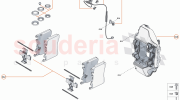
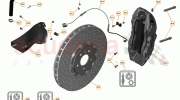
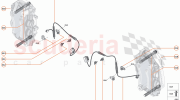
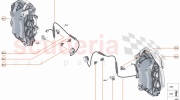


 Please wait...