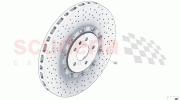
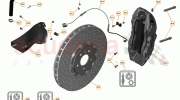
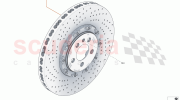
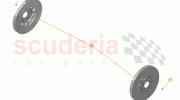
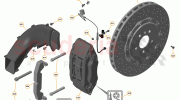
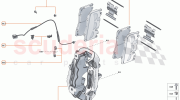
Scuderia Car Parts supplies genuine McLaren brake discs sourced directly from OEM manufacturers. McLaren offers two distinct braking disc technologies across its range: conventional cast iron ventilated discs on standard specifications, and carbon ceramic matrix (CCM) discs as an option or standard fitment on performance and Ultimate Series models. Both technologies have specific replacement requirements, and the disc specification — diameter, minimum thickness, vane geometry, and material — varies between model lines and between standard and CCM configurations. Getting the specification right is not optional on a vehicle where braking performance is a core safety and dynamic characteristic. Our team can advise on the correct disc specification for your exact model and brake system, and we supply customers across more than 85 countries.
Haven't found what you're looking for?
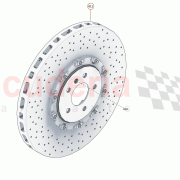
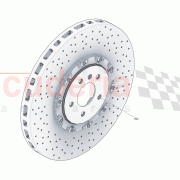
Brake discs on a McLaren convert the vehicle's kinetic energy into heat through friction with the brake pad. On cast iron systems, this heat is managed by the ventilated disc construction — internal radial vanes promote airflow through the disc core, drawing heat away from the friction surfaces and limiting thermal build-up. McLaren specifies disc diameter, thickness, and vane count precisely for each model and axle position to ensure the thermal capacity matches the vehicle's weight and maximum deceleration capability. Carbon ceramic matrix discs, used on higher-specification models, are manufactured from a composite of carbon fibres and silicon carbide, which gives them significantly higher thermal resistance and a longer service life than iron — but they are also more sensitive to cold use, requiring warm-up before full friction performance is available. CCM discs are substantially lighter than iron equivalents, contributing to a meaningful reduction in unsprung mass.
Cast iron brake discs should be measured for thickness at every service interval and replaced when approaching the minimum specification stamped on the disc face. Uneven wear, scoring, or pulsation through the brake pedal under progressive braking indicates that the disc surface requires investigation — scoring can result from pad debris, while pulsation typically indicates thermal distortion or variable disc thickness. Carbon ceramic discs should be inspected for radial cracking and delamination of the friction surface, which can occur following extreme thermal events such as repeated full-stop braking from high speed. CCM discs should not be used immediately after cold soaking — allow the brake system to reach operating temperature progressively before any hard application to avoid thermal shock cracking.
Genuine McLaren brake discs are manufactured to the diameter, thickness, vane geometry, and material specification validated for the specific model and braking system. The disc diameter determines the mechanical advantage of the calliper, and the vane geometry governs thermal dissipation — both must be correct for the braking system to perform as calibrated. On CCM installations, OEM discs are produced to the specific silicon carbide matrix specification that the pad compound is friction-matched to: a CCM disc from a non-specialist source may present a different surface composition that accelerates pad wear and reduces friction performance. ABS and stability control calibration also relies on consistent disc inertia; incorrect disc mass alters wheel deceleration response in ways that can affect electronic system accuracy. Scuderia Car Parts sources genuine McLaren OEM brake discs through established manufacturer relationships.



 Please wait...