Scuderia Car Parts specialises exclusively in luxury and exotic marques, and our range of Lamborghini radiators is sourced directly from OEM manufacturers to ensure exact specification every time. Whether you're replacing a cooling radiator on a Huracán, sourcing for a Gallardo rebuild, or working on an Aventador, Urus, or Murciélago, fitment precision is non-negotiable on vehicles engineered to these tolerances. Genuine Lamborghini OEM radiators carry the exact pressure ratings, core dimensions, and port configurations that Lamborghini specifies from the factory. We supply independent workshops and private owners across 85-plus countries, backed by genuine fitment knowledge — not guesswork. If you need the right part, correctly specified, our team is here to help you identify and source it quickly.
Haven't found what you're looking for?
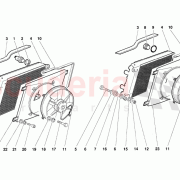
A Lamborghini's engine radiator carries enormous thermal responsibility. The naturally aspirated V10 found in the Huracán and Gallardo, and the V12 used across the Aventador, Murciélago, Diablo, and Countach lineage, generate sustained heat loads that demand precise coolant flow and heat dissipation. The radiator — a front-mounted heat exchanger — circulates coolant through a dense core of aluminium fins and tubes, transferring engine heat into the passing airflow. Core density, inlet and outlet diameter, and total surface area are all engineered specifically for each platform. A coolant radiator that deviates from OEM specification in any of these parameters risks inadequate cooling under the sustained high-rev conditions these engines are built to operate in.
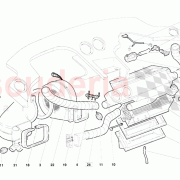
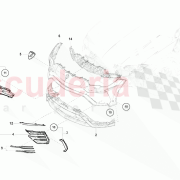
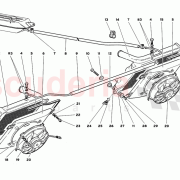
On mid-engined Lamborghinis such as the Huracán, Gallardo, Aventador, and Murciélago, radiators are typically mounted at the vehicle's front, with coolant lines running rearward to the engine bay. Some models use supplementary side-mounted radiators to assist with thermal management. Inspection should cover the core for stone damage, fin deformation, and corrosion, as well as checking hose connections and pressure caps for signs of weeping. Coolant should be replaced at manufacturer-specified intervals — typically every two to four years depending on model — using the correct fluid type. Warning signs of radiator failure include rising coolant temperature, visible coolant loss, or steam from the front of the vehicle. On the Urus, the front-end architecture differs, and correct identification of the specific radiator assembly is essential before ordering.
Genuine Lamborghini radiators are manufactured to the dimensional and pressure tolerances defined by Lamborghini's own engineering specifications, which means no adaptation, no approximation, and no risk of misalignment with existing hose routing or mounting points. On high-output platforms where thermal margins are tightly controlled, a correctly specified engine radiator is a reliability-critical component, not a commodity. Scuderia Car Parts sources genuine Lamborghini OEM radiators directly from approved manufacturers, ensuring that what you receive matches factory build quality. For workshops and owners who won't accept compromise on a vehicle of this calibre, genuine OEM is the only specification worth fitting.






 Please wait...