Scuderia Car Parts specialises exclusively in luxury and exotic marques, which means when you source Ferrari fenders through us, you are dealing with a team that understands the fitment demands and specification tolerances these cars require. We supply genuine OEM fenders for a broad range of models including the 488, F8 Tributo, SF90, Roma, Portofino, 296 GTB, 812 Superfast, GTC4Lusso, and iconic predecessors such as the F40, F50, and Enzo. Each front wing panel we stock is sourced directly from authorised manufacturers, ensuring the part reaching your workshop matches Ferrari's original engineering specification precisely. With customers across 85 or more countries, our sourcing relationships and worldwide delivery infrastructure mean the right part reaches you without compromise.
Haven't found what you're looking for?
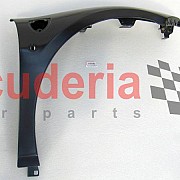
A Ferrari fender — or wing, as it is commonly called in body shop environments — is the outer body panel that covers and protects the wheel arch on either side of the vehicle. On a Ferrari, this component is not simply cosmetic. It contributes directly to aerodynamic stability at speed by managing airflow around the front wheels and into the wheel arch. Ferrari engineers the geometry of each fender to precise tolerances, varying the profile significantly between models; the sweeping front wing of an 812 Superfast shares little dimensionally with that of a 296 GTB or a Roma. The material specification also differs by model, with some variants using aluminium, composite blends, or carbon-reinforced structures that require exact OEM replacements to maintain structural integrity.
Ferrari fenders are mounted along each side of the front end of the vehicle, between the front bumper assembly and the A-pillar, enclosing the front wheel arch. On most current Ferrari models, they are secured via a combination of bolts and clips that interface with the front subframe and inner arch liner. Inspecting the quarter panel for damage should form part of any routine body inspection, particularly after any low-speed contact or kerbing incident. Common warning signs requiring attention include paint cracking along panel edges, visible deformation around the wheel arch lip, and corrosion around fixings on older models such as the F40 or F50. Panel gaps widening unevenly can also indicate a mudguard that has shifted or been previously replaced incorrectly.
Fit and finish on a Ferrari fender is engineered to extremely tight tolerances. A non-genuine part will rarely align correctly with the bonnet, bumper, and door shut lines, creating gaps that are visually obvious and structurally compromised. Genuine Ferrari fenders carry the exact mounting hole positions, arch radius, and surface profile of the original component, which matters both for appearance and for how the front wing panel interacts with the arch liner and aerodynamic trim. Paint adhesion is also affected by substrate quality. Scuderia Car Parts sources genuine OEM Ferrari fenders directly, giving garages and owners confidence that the part arriving for fitment is precisely what Ferrari intended for that specific model and build year.








 Please wait...